Young emperor penguins spend their first year at sea alone, so where do they go?Sanjana Gajbhiye Sun, November 22, 2026 at 1:37 PM UTC

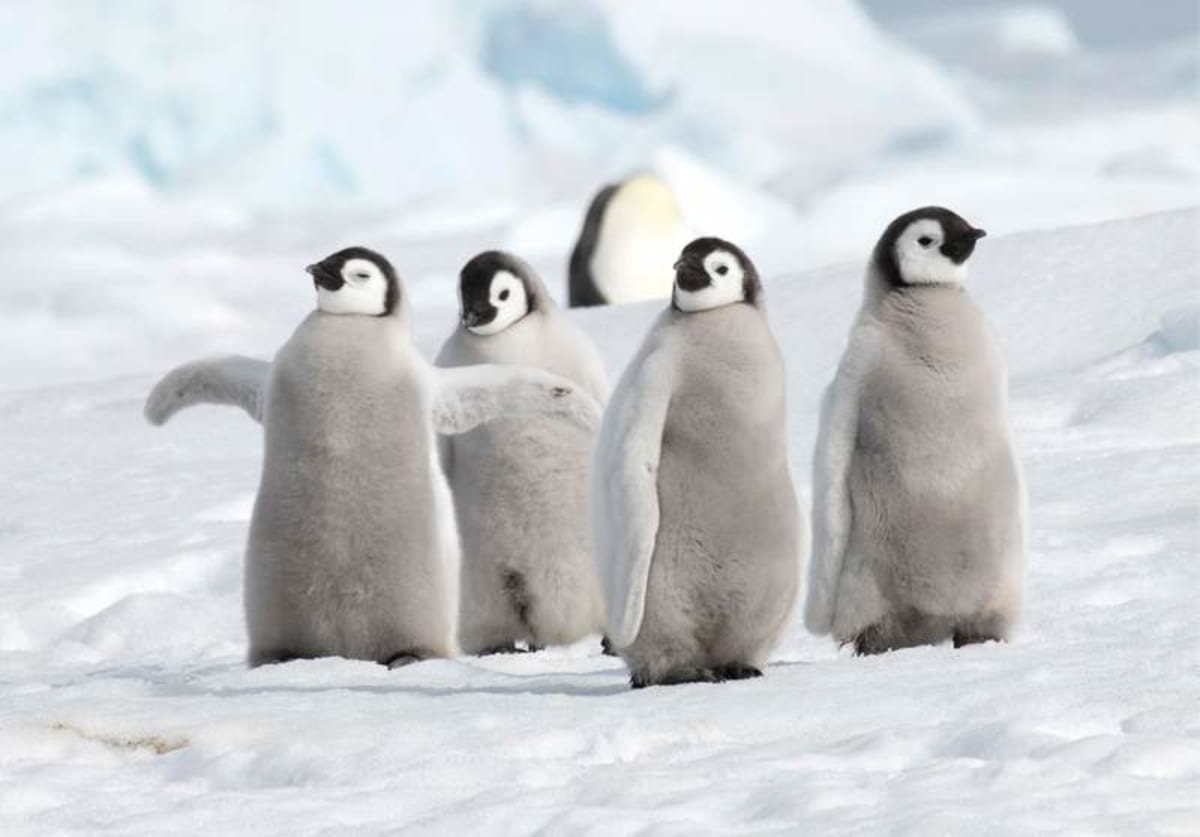
Emperor penguin chicks gather on the snow at Antarctica’s Snow Hill Island. Credit: Shutterstock
Juvenile emperor penguins are left to fend for themselves at sea for roughly a year after they fledge.
The young birds receive no guidance from their parents during this time and many do not survive it.
Their routes were still found to be strikingly similar in a study of three colonies around Antarctica’s Weddell Sea.
The recurring pattern can help planners estimate when juvenile penguins would spend time inside proposed marine protected areas.
Scientists discover similar journeys
The study was led by Émile Brisson-Curadeau, a postdoctoral researcher at the Centre for Functional and Evolutionary Ecology (CEFE).
Daniel Zitterbart of the Woods Hole Oceanographic Institution was a co-lead author. Céline Le Bohec of CEFE and the Centre Scientifique de Monaco shared that role.
“We were struck by the remarkable consistency of the penguins’ movements,” Brisson-Curadeau said.
Fishing vessel tracks were mapped as well, although the effect of fishing on the birds’ food was not measured.
Tracking the colonies’ young
Emperor penguins raise their chicks on sea ice that is attached to the coast of Antarctica.
The chicks develop waterproof feathers by late December and then leave for the open sea on their own.
Satellite tags were attached to 48 juveniles at the point when their new feathers had fully grown in.
A total of 28 birds came from Atka Bay at the eastern end of the Weddell Sea.
Around 8,000 pairs breed at that colony and its chicks were tagged over three summers between 2018 and 2023.
The remaining 20 juveniles were taken from Snow Hill Island and Jason Peninsula on the western side of the sea.
Tags reveal penguin movements
Each of these two colonies supports about 4,000 breeding pairs and their chicks were tagged during a single summer.
The movements of young emperor penguins from the western Weddell Sea had never been documented before this work.
Each tag was secured to the back feathers with tape and glue and weighed under 3% of body mass.
Most tags logged a position every four hours. Twelve of them also carried a pressure sensor for dive depth.
Similar routes across colonies
On average the juveniles travelled about 1,050 miles (1,688 km) from their colony at the farthest point of the trip.
The broad outline of this journey had already been described in earlier work carried out at Atka Bay.
No one had checked if it stayed the same across years, or across colonies on both sides of the sea.
In late summer, juveniles from Atka Bay, Snow Hill Island and Jason Peninsula all swam north.
By March, most had reached the waters just south of the Polar Front.
Here, cold Antarctic water meets warmer water from the north, and nutrient-rich upwelling feeds plankton and fish.
New sea ice starts forming in April. The penguins turned south to meet it and kept close to it all winter.
The ice reaches its greatest extent in August and September, and the birds moved north with its edge.
Once the ice began to melt, they headed back toward the continent.
Ocean features guide journeys
By late December, most of the juveniles still being tracked had returned to waters near the coast, where they are thought to molt.
Multiple years of tracking were only available at Atka Bay, which made a direct comparison between years possible there.
Birds tagged in the same year were spread about as far apart as birds that were tagged in different years.
The authors suggest the juveniles may be following two stable features, namely the Polar Front and the sea ice edge.
Sea ice sets the winter course
From April onward the position of the penguins was closely linked to how far north the sea ice extended. Before April the birds were swimming in open water that lay far away from any sea ice.
A total of 52,710 dives were recorded by the pressure sensors over the course of the study.
The average dive reached a depth of about 220 feet (68 m) and lasted a little more than three minutes.
The deepest dive recorded in the study went down to roughly 1,155 feet (352 m).
Dives tended to be shallow at night and deeper during daylight hours. Deeper dives were also observed farther north and where more of the sea surface was ice covered.
The authors wrote that the birds may feed on lanternfish when they are near the Polar Front.
These small deep-water fish contain more energy than the krill and silverfish eaten by breeding adults closer to Antarctica.
Protection matters in January
Two marine protected areas are already in place in the region and two more have been put forward. The Weddell Sea proposal has been developed by Germany and the European Union since 2012.
If adopted it would become the largest marine protected area in the world and include waters near all three colonies.
Juveniles from the western colonies already spent part of their time in existing protected areas. This share was 20.6% for Snow Hill Island birds and 29.3% for Jason Peninsula birds.
Atka Bay birds spent only 2.3% of their time in such zones by comparison.
January exposes vulnerable penguins
Atka Bay juveniles spent 31.6% of their tracked time in waters covered by the proposed protected areas.
Snow Hill Island and Jason Peninsula birds spent 21.0% and 14.7% of their time there.
Use of the proposed areas peaked in January, during the fledglings’ first weeks at sea.
Death rates among inexperienced juveniles are high in those first weeks at sea so the timing matters.
“Most marine protected areas in Antarctica are planned with penguin colonies in mind,” Zitterbart said.
“They protect the areas around the colonies, which is critical for adult penguins, but they fail to cover the sea areas where juveniles spend their vulnerable early years.”
Any new protected area in these waters needs the approval of every member of CCAMLR. This commission was set up in 1982 to conserve Antarctic marine life including krill.
Its members gathered in Hobart in October and left without agreeing on any new protected areas.
Fishing boats share the water
The main fishery in the region is aimed at Antarctic krill, which are small shrimp-like animals eaten by emperor penguins.
To estimate overlap the researchers relied on Global Fishing Watch, which is a public dataset of vessel activity.
It uses ship tracking signals to identify where fishing vessels are likely to be operating.
Fishing hours were totaled within about 62 miles (100 km) of each penguin location for the preceding year.
The waters used by juveniles from the two western colonies had more recorded fishing activity in the preceding year than the waters used by Atka Bay juveniles.
Much of this activity took place near the Antarctic Peninsula and in the waters around South Georgia.
Most of the overlap for these western birds occurred outside the boundaries of the planned protected areas.
Proposed areas restrict fishing
Around Atka Bay the fishing effort stayed low for most months of the year.
January was the exception since the birds then used zones that had been fished heavily in 2022 and 2023.
Those zones are located within the proposed protected areas. Krill fishing there would be restricted to research and capped at one metric ton per vessel per year.
For comparison a typical fishing vessel in the region harvests about 40,000 metric tons over a year.
“Sustainable management of fishing activities, particularly their timing and intensity in key foraging areas, is essential to securing the food emperor penguins need and limiting the risk of bycatch,” Le Bohec said.
Around one third of the global breeding population of emperor penguins is found in the Weddell Sea region.
The IUCN moved the species to Endangered in April after projecting that its numbers will halve by the 2080s.
That projection rests largely on the expected loss of Antarctic sea ice.
Does overlap mean less food?
The study measured overlap in space and time and not the direct effect of fishing on penguin foraging.
According to the authors direct studies of foraging success would give stronger evidence for the value of protection.
Tag losses also reduced the sample as the year went on and only 10 tags still reported in month 12.
Dive data were only available until September because none of the dive-recording tags transmitted beyond that month.
Sea ice extent was relatively stable between 2018 and 2024 including during an El Niño year.
Under continued warming the Polar Front is expected to contract toward Antarctica and winter sea ice could decline.
Juveniles might then travel shorter distances north but struggle to find suitable ice in winter.
A southward contraction would also raise overlap with the planned zones that are concentrated near the continent.
Future protection remains uncertain
According to the authors it remains to be determined whether this would offset the effects of climate change.
Accelerometers could be used in future work to link penguin foraging success with fishing pressure.
Foraging and breeding success could also be compared before and after protected areas come into force.
The Weddell Sea proposal has not been adopted and most of the juveniles’ year is spent outside protected waters.
The full study was published in the journal Biological Conservation.
—–
Like what you read? Subscribe to our newsletter for engaging articles, exclusive content, and the latest updates.
Check us out on EarthSnap, a free app brought to you by Eric Ralls and Earth.com.
—–
Source: Nature



0 Comments