Lab raised axolotls are surviving in the wild and gaining weight in a huge win for the rare speciesEric Ralls Fri, November 13, 2026 at 5:37 AM UTC

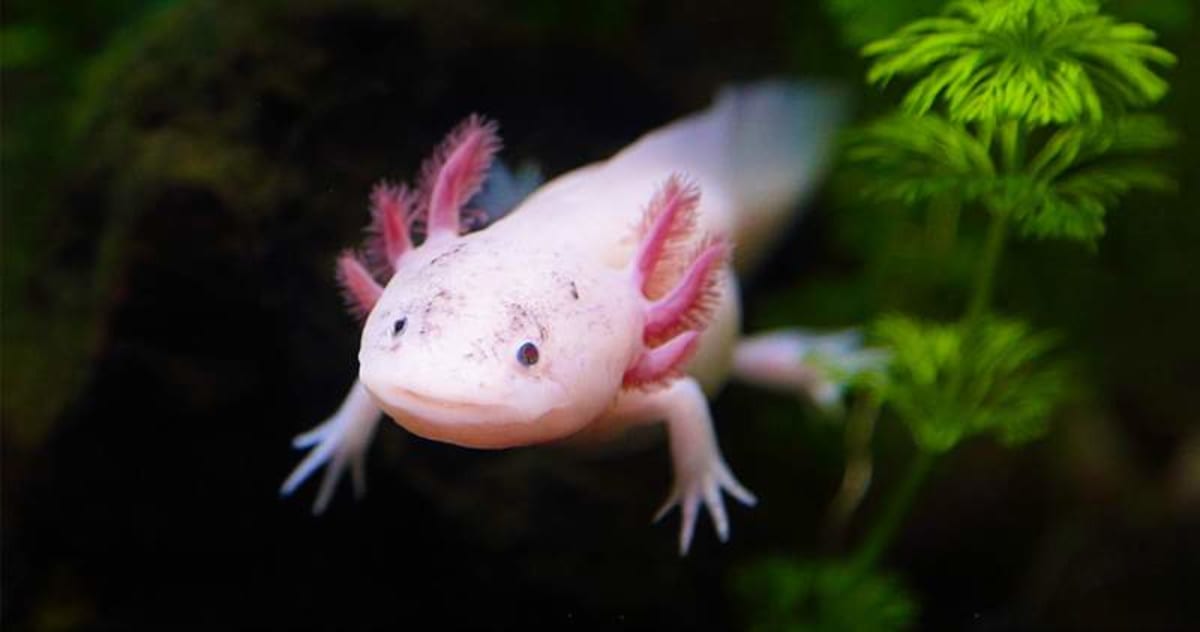
Cute pink axolotl (Ambystoma mexicanum). Credit: Shutterstock
Axolotls are popular as pets, in video games, and in research labs, but in the wild they are nearly gone. Their only natural home is Lake Xochimilco, a network of canals in southern Mexico City.
When scientists released 18 lab-raised axolotls into two of the city’s wetlands, all of them were still alive about six weeks later.
Two of the axolotls were later caught and weighed again. Both had gained weight. That weight gain suggests axolotls raised in captivity can still find their own food.
The quest to save axolotls
Alejandra Ramos of the Autonomous University of Baja California (UABC) led the study. She worked with Luis Zambrano and colleagues at the National Autonomous University of Mexico (UNAM), where the axolotls were bred.
Animals raised in captivity lose many of their behaviors, Ramos told NPR, including how to recognize a predator and catch prey.
“We were a bit nervous when we released them,” she said, because the team didn’t know whether the axolotls would survive.
The axolotl (Ambystoma mexicanum) is a salamander that keeps its juvenile features as an adult, including its feathery gills. It spends its whole life in the water.
The International Union for Conservation of Nature (IUCN) lists the species as critically endangered, with an estimated 50 to 1,000 adults left in the wild.
Two wetlands, 18 axolotls
Nine of the axolotls were male and nine were female. Horacio Mena, a veterinarian on the team, surgically implanted a radio transmitter in each one.
Each transmitter weighed about 0.07 ounces (2 grams), a little less than a dime and roughly 3% of an axolotl’s body weight.
In October 2017, the team released eight axolotls into a pond at La Cantera Oriente. The wetland isn’t natural. It formed about 30 years ago, when basalt mining brought underground springs to the surface.
The other 10 axolotls were released in March 2018 into a restored canal in Lake Xochimilco. The canal runs beside a chinampa, a kind of farming island the Aztecs built across the lake.
UNAM scientists set up a refuge there with local farmers, using filters that improve the water and keep out non-native fish.
Volunteers tracked the animals for about six weeks at each site, by rowboat at the pond and on foot at the canal.
Recaptured axolotls were heavier
All 18 axolotls survived the surgery and the weeks of tracking. The team later recaptured three of them, and two of those were weighed again.
One was a 2.5-year-old female, caught again at the pond three months after her release. She had gained about two-thirds of an ounce (18 grams). That was more than a quarter of her starting weight.
A male recaptured in the Xochimilco canal had gained about a tenth of an ounce (3 grams).
Pond axolotls roamed farther
The pond axolotls used far more space than the canal axolotls. A pond axolotl moved around an average area of about 29,600 square feet (2,747 square meters), roughly half a football field.
In the canal, the average area was about 4,100 square feet (382 square meters).
The authors wrote that the pond’s size likely explains the difference. The pond is more than 10 times as big as the canal, and its axolotls also traveled farther each day.
As the weeks went on, the pond axolotls traveled less each day. Ramos’s team suggested they explored at first, then settled once they had found good places to feed and shelter.
Movement peaked in cool water
At both sites, the axolotls moved the most in cool water, between roughly 60 and 63 degrees Fahrenheit (15.5 to 17 degrees Celsius). In warmer or cooler water, they moved less.
Neither site stayed in that range. Sensors recorded water as warm as 100 degrees Fahrenheit (38 degrees Celsius) in the canal and 87 degrees Fahrenheit (31 degrees Celsius) in the pond.
The authors wrote that the pond may be cooler and more stable than the canal. But they tracked the pond in late fall and the canal in spring, so the two sites weren’t measured at the same time.
Artificial wetlands like La Cantera Oriente could still give axolotls extra places to live, they suggested.
Egrets hunted in the canal
Not every axolotl stayed safe. After the tracking in Xochimilco ended, the researchers saw a great egret, a large wading bird, catch an axolotl in the canal. Local farmers reported seeing a great egret take another axolotl.
So the authors recommended training axolotls before future releases. The animals would be kept in enclosures and exposed to the sight and smell of predators.
Much more to learn about axolotls
Each group was tracked for about six weeks, and not during the warmest months of the year. Just two of the 18 animals were weighed again.
The canal is part of a restoration project that began in 2004, and teams have worked to remove invasive fish from both sites.
Raising axolotls in captivity is the easy part, Ramos said on NPR’s All Things Considered.
“If you do not make this restoration effort, then they’re going to die again,” she said.
The next question is whether released axolotls can survive over the long term and breed in these wetlands. Future research should track both, the authors wrote, and work out the best ways to train axolotls before release.
The full study was published in the journal PLOS One.
—–
Like what you read? Subscribe to our newsletter for engaging articles, exclusive content, and the latest updates.
Check us out on EarthSnap, a free app brought to you by Eric Ralls and Earth.com.
—–
Source: Nature



0 Comments